Middle East War Impact on Indian Investors: What Modi’s Parliament Speech Really Means for Your Money
Published: March 23, 2026 | Category: Market Updates, Mutual Funds | Reading time: 9 min
PM Narendra Modi addressed Lok Sabha at 2 PM today on the ongoing US-Israel-Iran war — and what he said directly affects your money, your LPG cylinder, your SIPs, and your mutual fund portfolio. This is a complete breakdown in plain language, with zero jargon.
What Is the Middle East Crisis and Why Does It Matter to India?
On February 28, the US and Israel launched a joint military operation against Iran, killing Supreme Leader Ayatollah Ali Khamenei on Day 1. Iran retaliated by striking neighbouring oil-exporting nations and shutting down the Strait of Hormuz — the narrow waterway through which nearly 20% of the world’s daily oil supply flows.
India is not at war. But economically, it is one of the most exposed countries in the world to this conflict.
Why Is India More Vulnerable Than Other Countries?
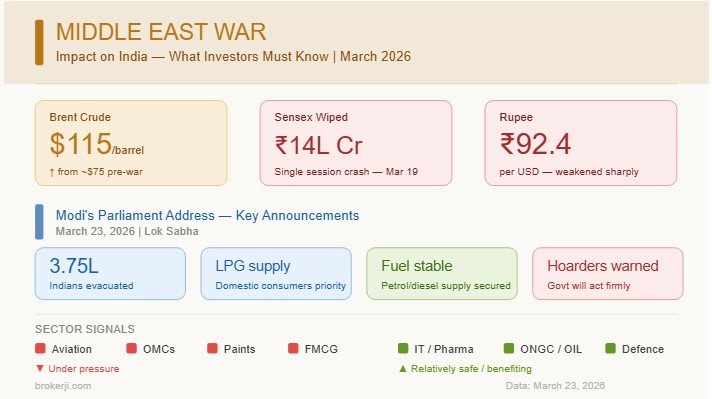
India imports over 88% of its total crude oil requirement — approximately 5 million barrels per day. Every $10 rise in oil prices inflates India’s annual import bill by $17–18 billion. With Brent crude now at $115 per barrel (up from ~$75 before the war began), the pressure on India’s current account deficit, rupee, and inflation is severe and immediate.
How Has the Crisis Already Hit Indian Markets?
The damage to Indian financial markets has been swift:
- Sensex crashed 2,500+ points on March 19, wiping out ₹14 lakh crore in investor wealth in a single session
- Nifty 50 fell below 23,000 — its steepest single-day fall since the COVID crash
- Foreign investors (FIIs) pulled out over ₹60,000 crore during the March series
- Rupee weakened to ₹92.4 per USD — its lowest level in recent times
- LPG cylinder prices jumped ₹60 in a week due to supply disruption
PM Modi’s Parliament Speech Today: 10 Key Points Decoded for Investors
Modi addressed Lok Sabha at 2 PM today — the first time he directly spoke to Parliament since the crisis escalated. Here are the 10 most important points, decoded for investors and common citizens.
India’s Official Stand on the Middle East War
Modi told Parliament that the situation in West Asia is “deeply worrying” and poses new challenges for India. He stated clearly that India’s concerns are greater than most countries given its extensive trade, energy, and human ties with the region. He called for a united voice from Parliament to send a clear message to the world.
Status of Indians in the War Zone
Over 3,75,000 Indians have returned home safely since the war began. From Iran alone, nearly 1,000 nationals were evacuated — including over 700 medical students. Indian missions across the region are actively helping remaining workers and tourists.
What About the 90 Lakh Indians Still Working in the Gulf?
Approximately 9 million Indians are employed across the Gulf region. Modi confirmed he personally held two rounds of diplomatic discussions with West Asian leaders, who gave assurances about the safety of Indian nationals. Remittances from the Gulf account for over 1% of India’s GDP — any large-scale disruption here would have serious macro consequences.
What Modi Said About Petrol, Diesel, and LPG Prices
This is what most Indian households need to know:
- LPG: India imports 60% of its LPG requirement. Modi announced that domestic consumers will receive first priority in supply allocation. Supply stability was guaranteed — but no price cut was announced.
- Petrol and Diesel: Supply chains have been stabilised. No shortage will be allowed. Price revision will depend on how long the conflict continues.
- Hoarders Warning: Modi issued a direct warning in Parliament — the government will act firmly against anyone creating artificial scarcity.
Should You Expect a Petrol Price Cut Soon?
Not immediately. The government is focused on supply stability rather than price relief in the short term. Any excise duty cut would depend on crude sustaining above $110 for an extended period. Watch for the RBI’s April 2026 monetary policy meeting — that will give stronger signals on the government’s inflation-vs-growth trade-off.
CBSE Students in the Gulf
CBSE has cancelled all board examinations scheduled in the Middle East. Affected students have been given alternative arrangements and the government has committed to protecting their academic year.
Sector-by-Sector Impact: Where Is the Risk in Indian Markets Right Now?
Not all sectors are equally exposed to the Middle East crisis. Here is a clear breakdown for Indian investors — which sectors face direct pressure, and which are relatively protected.
Sectors Under Direct Pressure
These sectors face earnings pressure because of higher crude costs, currency depreciation, or supply chain disruption from the Gulf region.
Aviation Sector — Highest Risk
Jet fuel (ATF) accounts for 35–40% of an airline’s operating expenses. With crude at $115, the aviation sector faces severe margin compression unless fuel surcharges are raised. The sector is best avoided for fresh positions until crude shows a clear trend downward.
Oil Marketing and Downstream Fuel Sector
The government is holding retail fuel prices to protect consumers. This means downstream fuel marketers are absorbing the difference between rising input costs and capped selling prices. Their under-recovery per litre is rising daily. Expect continued earnings pressure in this sector until either crude falls significantly or retail prices are revised upward.
Paints, Chemicals, and Tyre Sector
Crude oil derivatives form 20–30% of input costs for these sectors. Higher crude directly squeezes their gross margins. Quarterly results guidance for Q4 FY26 is likely to disappoint. The pain is real but temporary — once crude stabilises, margins recover quickly in these sectors.
FMCG and Edible Oil Sector
Edible oil prices have jumped ₹11–₹20 per kg due to Gulf supply chain disruption. Additionally, logistics and freight costs are elevated. This sector will show margin pressure in the near term, though domestic demand remains strong and structural growth intact.
Private Banks with High Gulf NRI Exposure
Banks that have significant NRI deposit and remittance exposure to the Gulf region face a specific risk — if a large number of Indian workers face job losses or evacuation, remittance inflows fall sharply. This is a sector to monitor, not necessarily to exit, but risk is elevated.
Sectors That Are Relatively Safe or Benefiting
IT and Technology Sector — Dollar Earners Gain
India’s IT sector earns primarily in US dollars. A weakening rupee (now ₹92.4 per USD) directly boosts their reported revenues and profits in INR terms when results are announced. This is one of the clearest natural hedges in the Indian market during any rupee depreciation cycle. The sector typically outperforms during global geopolitical uncertainty.
Pharmaceutical Sector — Export Earnings Protected
Pharma exports are dollar-denominated. Similar to IT, the weaker rupee improves realisations for pharma companies with strong US and global export revenues. The sector is also largely insulated from direct crude or Gulf supply chain disruption.
Upstream Oil and Gas Sector — Direct Beneficiary
Higher global crude prices directly improve per-barrel realisation for upstream oil producers. This sector is a natural beneficiary of oil price spikes and acts as a portfolio hedge during energy-driven crises. Unlike downstream fuel marketers who absorb the cost, upstream producers capture the revenue upside.
Defence Sector — Structural Tailwind
Geopolitical conflict drives increased defence procurement both globally and domestically. India’s defence budget allocation is structurally growing and this crisis accelerates it further. The defence sector has a long-term tailwind that is independent of the war’s duration.
Should You Stop Your SIP During the Middle East War? The Honest Answer
This is the most important question for retail investors right now. The answer is straightforward: do not stop your SIP.
What Happens to Your SIP When the Market Falls Due to War?
When markets fall, your monthly SIP buys more units of the same fund at lower prices. This is called Rupee Cost Averaging — and it is the single most powerful mechanism that makes SIPs work over a long period. A falling market is not bad news for a SIP investor. It is actually an opportunity — you are buying the same fund at a discount.
What History Tells Us About War-Driven Market Crashes
History is consistent on this point. Every major war-driven correction in Indian markets has been followed by a strong recovery:
| Crisis | Sensex Fall | 12-Month Recovery |
|---|---|---|
| Gulf War 1990 | −25% | +80% |
| 9/11 Attacks 2001 | −18% | +45% |
| Iraq War 2003 | −15% | +73% |
| Russia-Ukraine 2022 | −17% | Full recovery in 8 months |
In every instance, investors who stopped SIPs locked in losses. Investors who continued — or increased their SIP amount — saw the highest long-term returns. The current Middle East war impact on Indian investors follows this same historical template.
What If You Are Close to a Financial Goal?
If you have a financial goal within the next 1–2 years — a home down payment, a child’s education, a wedding — this is the right time to review your equity allocation with your Mutual Fund Distributor. The goal is not to exit equity entirely, but to ensure money needed in the near term is moved to lower-risk options like debt funds or arbitrage funds. Do not expose short-term goal money to equity market volatility during a crisis.
What Should You Do With Idle Cash During This Crisis?
If you have money sitting in a savings account earning 3.0–3.5% per annum, this crisis is a reminder that idle cash loses real value to inflation. Here are the two smartest parking options for Indian investors right now.
Arbitrage Funds: Low Risk, Tax-Efficient, and Liquid
Arbitrage funds exploit the price difference between the cash market and the futures market. They are fully hedged — every buy position is matched with a futures sell — which means they carry near-zero directional market risk. They do not go down when the market crashes.
Key Features of Arbitrage Funds Right Now
- Expected returns: 6.5–7.5% annualised (significantly above savings account)
- Liquidity: Redemption processed in 1–3 working days
- Tax treatment: Classified as equity funds — 15% STCG within 1 year, 10% LTCG after 1 year
- Risk level: Very low — market-neutral by design
- Ideal for: Money you may need in the next 3–12 months
During volatile markets, arbitrage spreads actually widen — which means arbitrage funds earn more during periods of high volatility. This makes them a uniquely suitable option precisely during a crisis like this one.
Short-Duration Debt Funds for Conservative Investors
If you prefer no equity exposure at all, short-duration debt funds with a 1–3 year maturity profile offer 6.5–7.8% yields currently. Given that the RBI is unlikely to cut rates aggressively during an inflationary oil price shock, short-duration is safer than long-duration bond funds right now. Avoid long-duration bond funds until there is clarity on RBI’s rate path.
The Bigger Picture: How Long Will This Middle East War Impact India?
What India Is Already Doing to Protect Its Economy
The government’s response has been faster and more coordinated than in previous energy crises:
- Strategic petroleum reserves are being evaluated for deployment to bridge any supply gap
- Alternative crude sourcing from Russia (already supplying ~40% of India’s crude at discounted rates) and the US is being actively ramped up
- RBI is intervening in forex markets to prevent a disorderly depreciation of the rupee
- Domestic institutional investors (mutual funds and insurance companies) are absorbing FII selling — they bought ₹5,500 crore on the same day FIIs sold ₹5,300 crore in mid-March
What Could Trigger a Market Recovery?
Watch for these specific signals — any one of them could trigger a sharp positive market reaction:
- Ceasefire or de-escalation talks between the US/Israel coalition and Iran
- Strait of Hormuz partially reopening — even partial shipping resumption could drop crude by $15–20
- RBI liquidity or rate action to stabilise the rupee and support growth
- OPEC+ emergency production increase to compensate for Gulf supply loss
- US diplomatic pressure for ceasefire — the US economy also suffers from $115 crude
Should You Be Worried About Your Mutual Fund Portfolio Right Now?
Informed — yes. Panicked — no. There is an important difference between the two.
Being informed means staying updated, reviewing your allocation, and making rational decisions. Being panicked means making irreversible decisions — stopping SIPs, redeeming equity funds — based on short-term fear. Panic is what costs investors real money in crises like these.
A well-diversified equity mutual fund is already spread across multiple sectors — including IT, pharma, defence, and domestic consumption — which are either insulated or benefiting from the current crisis. Trust the diversification. Continue your SIPs. Review your asset allocation calmly with your financial advisor.
One Number to Remember: DIIs Absorbed Every FII Sale in March
Domestic institutional investors — primarily Indian mutual funds where your SIP money goes — have been buying aggressively every single day that foreign investors have been selling. This is a sign of fundamental domestic confidence in Indian markets despite the external shock. Your SIP money is being put to work at lower prices by professional fund managers. That is exactly how it should work.
Quick Action Checklist for Indian Investors
- ✅ Continue all SIPs — do not pause or stop
- ✅ Park idle savings in Arbitrage Funds rather than a savings account
- ✅ Reduce fresh exposure to aviation, downstream fuel, and crude-linked sectors
- ✅ Watch for de-escalation signals — markets will react sharply and positively
- ✅ If within 2 years of a financial goal — review equity allocation with your MFD immediately
- ✅ Do not make any irreversible exit decisions based on short-term fear
Frequently Asked Questions
Will petrol and diesel prices increase in India due to the Middle East war?
The government has confirmed supply stability and is working to prevent shortages. However, no price cut has been announced. A price increase is unlikely in the short term given political sensitivities, but continued high crude prices for 3–4 months could force a revision. The situation is being monitored closely.
Is it safe to invest in mutual funds right now during the Middle East war?
Yes — for long-term investors with a 5+ year horizon, this is actually an attractive buying opportunity. Market corrections driven by external geopolitical events are historically temporary. Systematic investment through SIPs is the safest way to invest during this kind of volatility. Avoid lump-sum entry in directly crude-exposed sectors until the situation becomes clearer.
How does the Middle East war affect India’s economy directly?
India is affected through four main channels: (1) higher crude oil import costs widening the current account deficit, (2) rupee depreciation which raises imported inflation, (3) potential disruption to remittances from 9 million Indians working in the Gulf, and (4) disruption to trade routes which affects both exports and imports. Of these, the crude oil impact is the most immediate and severe.
What should I do with my SIP during the current market crash?
Continue your SIP without interruption. When markets fall, your SIP automatically buys more units at lower prices — this is Rupee Cost Averaging working in your favour. Investors who stopped SIPs during COVID-19, the Russia-Ukraine war, and previous oil shocks all underperformed investors who stayed the course. The data on this is very clear and consistent.
Is LPG supply safe for Indian households?
Yes. PM Modi confirmed in Parliament that domestic LPG consumers have been given first priority in supply allocation. The government has directed refineries to prioritise cooking gas production. While prices may remain elevated, there will be no shortage for household consumers.
Which sectors benefit from rising crude oil prices in India?
The upstream oil and gas sector benefits directly from higher crude realisation prices. The IT sector and pharmaceutical export sector benefit indirectly through a weaker rupee boosting their dollar-denominated earnings. The defence sector benefits from increased government focus on strategic preparedness during geopolitical tension.
Have questions about how the Middle East war and current market conditions affect your personal financial goals? Connect with a SEBI-registered Mutual Fund Distributor for a personalised portfolio review.