
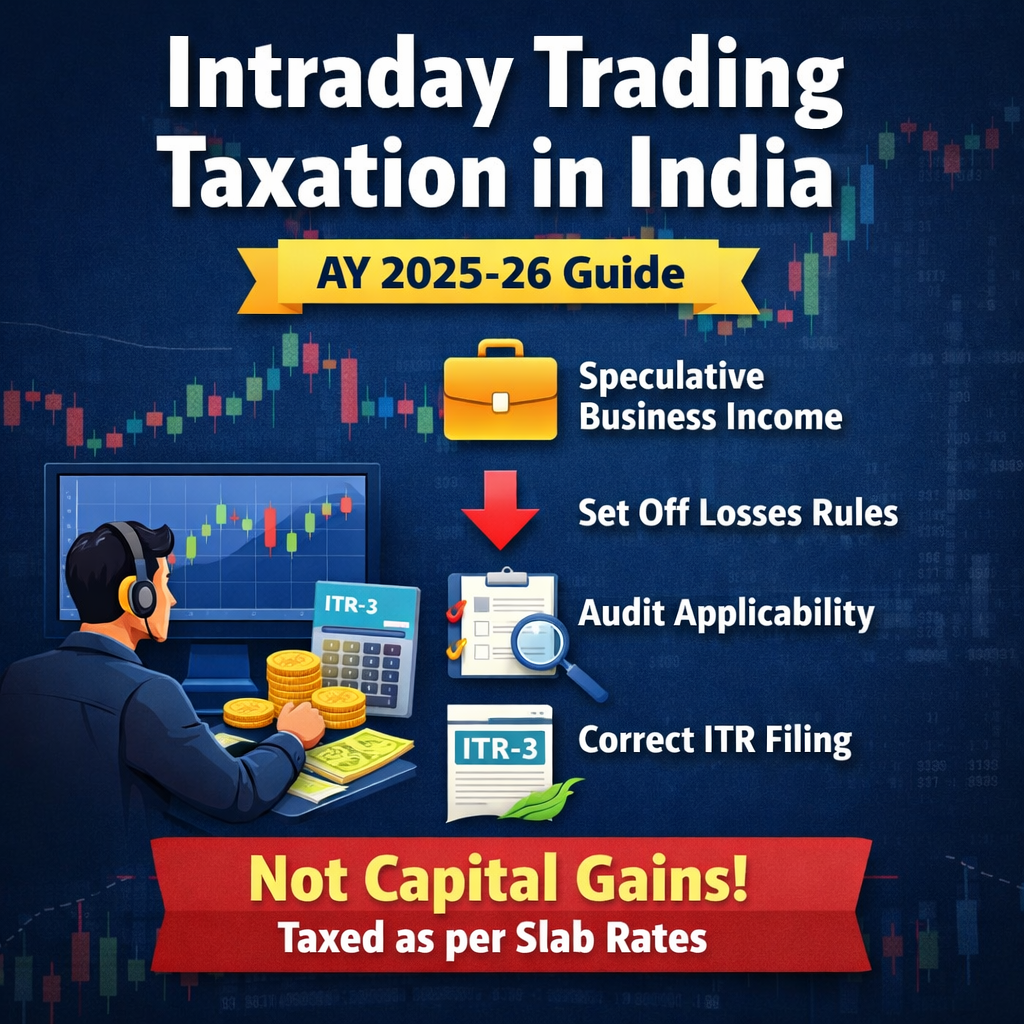
Intraday trading has become very common among retail investors in India. However, when it comes to income tax filing, many traders either file incorrectly or miss important rules.
Table of Contents
ToggleIf you are doing intraday trading during Financial Year 2024–25 (Assessment Year 2025–26), this guide will help you understand taxation, loss rules, audit applicability, and ITR filing in a simple and practical way.
What is Intraday Trading as per Income Tax?
Intraday trading means buying and selling shares on the same day without taking delivery.
As per the Income Tax Act:
Intraday trading is treated as Speculative Business Income.
This is the most important concept every trader must understand before filing ITR.
Why Intraday Trading is NOT Capital Gains
Many traders wrongly assume intraday profits are taxed like delivery-based trading.
This is incorrect.
Intraday trading:
- Is NOT Short-Term Capital Gain (STCG)
- Is NOT taxed at 15%
Instead:
- It is treated as business income
- It is taxed as per your applicable income tax slab
How Intraday Trading Income is Taxed
Intraday profits are added to your total income and taxed as per slab rates under:
- Old Tax Regime
- New Tax Regime
Example:
If your total income including intraday profit is ₹8,00,000 in FY 2024–25, tax will be calculated as per slab rates.
Intraday Loss Rules (Speculative Loss)
Loss from intraday trading is classified as Speculative Loss.
Set-off Rules
- Can be set off only against speculative income
- Cannot be adjusted against salary, F&O income, or capital gains
Carry Forward Rules
- Can be carried forward for 4 years
- You must file ITR before the due date to claim this benefit
Failing to file on time will result in loss of carry forward benefit.
How to Calculate Intraday Turnover
Turnover is often misunderstood by traders.
Turnover is calculated as:
Absolute Profit + Absolute Loss
Example
- Profit = ₹50,000
- Loss = ₹70,000
Turnover = ₹1,20,000
Note: Turnover is NOT the total traded value.
Tax Audit Rules for Intraday Traders (FY 2024–25)
Tax audit applicability is one of the most important and misunderstood areas.
It does NOT depend on a single fixed limit. It depends on turnover, profit declared, and nature of transactions.
1. Basic Audit Limits
- ₹1 crore turnover limit for business
- Increased to ₹10 crore if 95% of transactions are digital (which is usually the case for traders)
2. Presumptive Taxation (Section 44AD)
Intraday traders can opt for presumptive taxation (if eligible):
- Declare profit at 6% or more of turnover (for digital transactions)
- No audit required if within turnover limits
3. When Audit Becomes Mandatory
Audit may be required if:
- Turnover exceeds ₹10 crore (in most trading cases)
- OR you declare profit less than 6% of turnover AND your total income exceeds the basic exemption limit
- OR you opt out of presumptive taxation after choosing it earlier (lock-in rules may apply)
Important Note
Most intraday traders fall under digital transactions, so ₹10 crore limit is generally applicable, but low profit declaration can still trigger audit.
Ignoring audit rules can result in notices and penalties.
Which ITR Form to Use for Intraday Trading
Intraday traders should generally file:
ITR-3 (for business income)
Filing under the wrong form (like ITR-2) is a common mistake.
Common Mistakes Intraday Traders Make
- Filing intraday income under capital gains
- Ignoring speculative losses
- Not matching income with AIS/TIS
- Not maintaining proper records
- Ignoring audit applicability
These mistakes can lead to notices or loss of tax benefits.
Old vs New Tax Regime – Which One to Choose?
For FY 2024–25:
- New Tax Regime offers lower tax rates but fewer deductions
- Old Tax Regime allows deductions like 80C, 80D, etc.
Traders should calculate tax under both regimes before filing.
Practical Tips for Intraday Traders
- Reconcile profit/loss with broker statements
- Maintain trade-wise records
- File ITR before due date
- Do not ignore small profits or losses
- Plan taxes in advance
Conclusion
Intraday trading taxation is straightforward once you understand that it is treated as speculative business income.
The biggest issue is incorrect filing, not taxation itself.
Correct filing helps you:
- Stay compliant
- Carry forward losses
- Avoid notices
- Optimize tax liability
Need Help with Intraday Trading ITR Filing?
If you are an active trader filing for FY 2024–25 (AY 2025–26), professional guidance can help you avoid costly mistakes and maximize benefits.
Frequently Asked Questions (FAQs)
Is intraday trading taxed as capital gains?
No, intraday trading is treated as speculative business income and taxed as per slab rates.
Can intraday losses be set off against salary?
No, speculative losses can only be set off against speculative income.
How many years can intraday losses be carried forward?
Intraday losses can be carried forward for 4 years, provided ITR is filed on time.
Is tax audit mandatory for intraday traders?
Audit depends on turnover, profit percentage, and income level. It is not mandatory in all cases.
Which ITR form is used for intraday trading?
ITR-3 is generally used for intraday trading income.

Madhup Kulshrestha
Brokerji.com
Join me on journey to a healthier finance !